What Was the Beef During Pinkerton
| Butch Cassidy | |
|---|---|
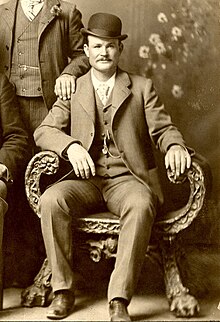 Fort Worth, Texas, 1900 | |
| Built-in | Robert LeRoy Parker (1866-04-thirteen)April xiii, 1866 Beaver, Utah Territory, U.S. |
| Died | Nov 7, 1908(1908-11-07) (aged 42) Bolivia |
| Cause of death | Gunshot wounds |
| Other names | Butch Cassidy, Mike Cassidy, George Cassidy, Jim Lowe, Santiago Maxwell |
| Occupation | Subcontract mitt, cowboy, butcher, thief, robber, gang leader, outlaw |
| Allegiance | Butch Cassidy's Wild Bunch |
| Conviction(s) | Imprisoned in the territorial prison house in Laramie, Wyoming for equus caballus theft |
| Criminal charge | Horse theft, cattle rustling, bank and railroad train robbery |
| Penalty | Served eighteen months of ii-yr sentence; released January 1896 |
Robert LeRoy Parker (April thirteen, 1866 – November 7, 1908), ameliorate known as Butch Cassidy,[1] was an American train and banking company robber and the leader of a gang of criminal outlaws known every bit the "Wild Bunch" in the Onetime West.
Parker engaged in criminal activity for more than than a decade at the end of the 19th century and the early 20th century, but the pressures of existence pursued past law enforcement, notably the Pinkerton detective bureau, forced him to flee the country. He fled with his accomplice Harry Longabaugh, known every bit the "Sundance Kid", and Longabaugh's girlfriend Etta Identify. The trio traveled first to Argentina and then to Bolivia, where Parker and Longabaugh are believed to have been killed in a shootout with the Bolivian Regular army in November 1908; the verbal circumstances of their fate proceed to be disputed.
Parker's life and death have been extensively dramatized in motion-picture show, television, and literature, and he remains 1 of the nigh well-known icons of the "Wild Westward" mythos in modernistic times.
Early life [edit]
Robert LeRoy Parker was built-in on April 13, 1866, in Beaver, Utah Territory, the first of thirteen children of English language immigrants Maximillian Parker and Ann Campbell Gillies.[2] [3] [four] The Parker and Gillies families had converted to the Mormon religion while however living in the United Kingdom. Maximillian Parker was 12 years old when his family arrived in Salt Lake City in 1856 every bit Mormon pioneers.[five] Ann Gillies was born and lived in Tyneside in northeast England before immigrating to the U.S. with her family unit in 1859 at age 14.[half-dozen] [7] [8] The couple were married in July 1865.[ix] Robert Parker grew upwardly on his parents' ranch near Circleville.[x]

The log cabin in Circleville, Utah, where Robert LeRoy Parker grew up
Parker fled his home as a teenager, and while working on a dairy ranch, met cattle thief Mike Cassidy. He subsequently worked on several ranches, in add-on to a brief apprenticeship with a butcher in Rock Springs, Wyoming, where he got his nickname (by the discussion "butcher", which morphed afterwards into "Butch"), to which he soon added the last name Cassidy in honor of his sometime friend and mentor.
Criminal career [edit]
Butch Cassidy'due south offset criminal offense was small. Around 1880, he journeyed to a clothier's shop in another boondocks, but establish information technology closed. He broke into the shop and stole a pair of jeans and some pie, leaving an IOU promising to pay on his next visit. The clothier pressed charges, but Cassidy was acquitted past a jury. He continued to piece of work on ranches until 1884, when he moved to Telluride, Colorado, ostensibly to seek work, but mayhap to deliver stolen horses to buyers. Cassidy led a cowboy'southward life in Wyoming and Montana earlier returning to Telluride in 1887, where he met Matt Warner, the owner of a racehorse. Cassidy and Warner raced the horse at various events, dividing the winnings betwixt them.
1889–1895 [edit]

The white building at right housed the San Miguel Valley Depository financial institution, the site of Cassidy'due south first bank robbery in 1889.

Butch Cassidy'due south cattle brand of "Reverse-Due east, Box, E"[11]
Cassidy'due south first banking company robbery took place on June 24, 1889, when Warner, two of the McCarty brothers, and he robbed the San Miguel Valley Depository financial institution in Telluride. Businessman L. L. Nunn had taken a controlling interest in the bank the previous year.[12] The robbers stole around $21,000 (equivalent to $633,000 in 2021), after which they fled to the Robbers Roost, a remote hideout in southeastern Utah.
In 1890, Cassidy purchased a ranch on the outskirts of Dubois, Wyoming. This location is across the state from the notorious Hole-in-the-Wall, a natural geological germination, and a popular hideout for outlaw gangs, including Cassidy's, during the era. Cassidy'southward ranching was possibly a façade for clandestine activities, perhaps with Hole-in-the-Wall outlaws, as he was never financially successful at ranching.[thirteen] Cassidy's ranch used the "unmistakable brand" of "Reverse-E, Box, East".[xi]
In early on 1894, Cassidy became involved romantically with rancher and outlaw Ann Bassett. Her father was a rancher who did business with Cassidy, supplying him with fresh horses and beef. That aforementioned year, Cassidy was arrested at Lander, Wyoming, for stealing horses and maybe for running a protection noise among the local ranchers there. He was imprisoned in the Wyoming State Prison in Laramie, where he served 18 months of a 2-year sentence; he was released and pardoned in January 1896 by Governor William Alford Richards.[xiv] He became involved briefly with Bassett's older sister Josie earlier returning to Ann.
Formation of the Wild Bunch [edit]
Cassidy associated with a wide circle of criminals, most notably his closest friend William Ellsworth "Elzy" Lay, Harvey "Child Back-scratch" Logan, Ben "The Tall Texan" Kilpatrick, Harry Tracy, Will "News" Carver, Laura Bullion, and George "Flat Nose" Curry, who collectively became the so-chosen "Wild Bunch". The gang assembled onetime later Cassidy'southward release from prison in 1896, and took its name from the Doolin–Dalton gang, also known as the "Wild Bunch".[fifteen]

Cassidy'south mugshot from the Wyoming Territorial Prison in 1894
On August 13, 1896, Cassidy, Lay, Logan, and Bob Meeks[16] robbed the bank at Montpelier, Idaho, escaping with roughly $7,000. Cassidy recruited Harry Alonzo Longabaugh, also known equally the "Sundance Child", into the gang soon later on.
Bassett, Lay, and Lay's girlfriend Maude Davis all joined Cassidy at Robbers Roost in early on 1897. The four hid in that location until early Apr, when Lay and Cassidy sent the women home so that the men could programme their adjacent robbery. They ambushed a small grouping of men conveying the payroll of the Pleasant Valley Coal Company in the mining town of Castle Gate, Utah, on April 22, 1897, stealing a sack of silver coins, with which they fled back to the Robbers Roost.[17]
On June 2, 1899, the gang robbed a Union Pacific Overland Flyer passenger train near Wilcox, Wyoming, a robbery that earned them a great bargain of notoriety and resulted in a massive manhunt.[18] [xix] Many notable lawmen took function in the hunt, but they did non find them. Kid Curry and George Curry had a shootout with lawmen following the train robbery, killing Sheriff Joe Hazen. Tom Horn, a killer-for-hire employed by the Pinkerton National Detective Agency, was told by explosives skilful Pecker Speck about the Hazen shooting. Pinkerton detective Charlie Siringo was then assigned the chore of capturing the outlaws. He became friends with Elfie Landusky, who was using the last name Curry after becoming pregnant by Kid Curry's blood brother Lonny Logan, and Siringo intended to locate the gang through her.
On July 11, 1899, Lay and others were involved in a Colorado and Southern Railroad train robbery almost Folsom, New Mexico, which Cassidy might have planned and personally directed. A shootout ensued with local law enforcement, during which Lay killed Sheriff Edward Farr and Henry Love; Lay was convicted of murder and sentenced to life imprisonment at the New United mexican states State Penitentiary.
The Wild Bunch typically separated following a robbery and fled in unlike directions, afterwards reuniting at a predetermined location such equally the Hole-in-the-Wall, Robbers Roost, or Fannie Porter'southward brothel in San Antonio.
1899 plea for immunity [edit]
Cassidy approached Utah Governor Heber Wells to negotiate an amnesty. Wells advised him to ask the Wedlock Pacific Railroad to drop their criminal complaints against him, and Marriage Pacific chairman East. H. Harriman attempted to meet with Cassidy through Warner. On Baronial 29, 1900, Cassidy, Longabaugh, and others robbed Marriage Pacific train No. three near Tipton, Wyoming, breaking Cassidy's earlier promise to the governor of Wyoming and ending any chance for amnesty.
1900–01 [edit]
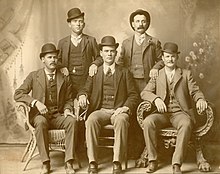
"Fort Worth Five", December 1900; Cassidy is seated on the far right Click a person for more than information. Click elsewhere on the image for a larger epitome.
On February 28, 1900, lawmen attempted to abort Lonny Logan at his aunt's home. Lonny was killed in the shootout that followed, and his cousin Bob Lee was arrested for rustling and sent to prison in Wyoming. On March 28, George Curry and News Carver were pursued past a posse from St. Johns, Apache County, Arizona, after using currency they had stolen in the Wilcox train robbery. The posse engaged them in a shootout, during which Deputies Andrew Gibbons and Frank LeSueur were killed, while Carver and Curry escaped. On April 17, George Curry was killed in a shootout with 1000 County, Utah, Sheriff John Tyler and Deputy Sam Jenkins. On May 26, Kid Curry rode into Moab, Utah, and killed both Tyler and Jenkins in another shootout in retaliation for the deaths of George and Lonny.
In December, Cassidy posed aslope Longabaugh, Logan, Carver, and Ben Kilpatrick in Fort Worth, Texas, for the now-famous "Fort Worth V" photo. The Pinkerton Agency obtained a copy of the photograph and began to use it for wanted posters.
On July 3, 1901, Child Curry and a group of men robbed a Slap-up Northern railroad train near Wagner, Montana,[twenty] stealing more than $60,000 in cash (equivalent to $one,950,000 in 2021). The gang separate upward, but a posse led past Sheriff Elijah Briant caught upwards with News Carver and killed him. Kilpatrick was captured in St. Louis on November v at Josie Blakey's resort on Anecdote Street. In his pocket, they found a key to a room at The Laclede Hotel. The side by side morning, they found Laura Bullion in the lobby, checking out with her luggage. In her valise was $8500 in unsigned banknotes from the Great Northern robbery. Curry killed Knoxville policemen William Dinwiddle and Robert Saylor in another shootout on Dec thirteen, so escaped. He returned to Montana, pursued by Pinkertons and other police enforcement officers, where he shot and killed rancher James Winters in retaliation for killing his brother Johnny years before.[21]
Escape to Due south America [edit]
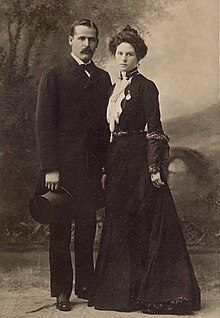
Cassidy and Longabaugh fled to New York Metropolis, feeling continuous pressure from the numerous law enforcement agencies pursuing them and seeing their gang falling apart. They departed from there to Buenos Aires, Argentina aboard the British steamer Herminius on February 20, 1901,[22] [23] [24] [25] along with Longabaugh's companion Etta Identify. Cassidy posed as James Ryan, Place's fictitious blood brother. They settled in a four-room log motel on a 15,000-acre (61 km2) ranch that they purchased on the east bank of the Rio Blanco near Cholila, only eastward of the Andes in the Chubut.
Bruce Chatwin's In Patagonia references a letter Butch wrote from Cholila to Elza Lay'due south female parent-in-police in Utah, dated August 10, 1902. The letter of the alphabet cites "our picayune family of 3" living in a 4 room house with 300 cattle, 1500 sheep, and 28 horses. Chatwin states the letter resides with the Utah State Historical Club.[26]
1905 [edit]
Two English language-speaking bandits held up the Banco de Tarapacá y Argentino in Río Gallegos on February xiv, 1905, 700 miles (1,100 km) south of Cholila near the Strait of Magellan, and the pair vanished north across the Patagonian grasslands. Cassidy and Longabaugh sold the Cholila ranch on May one, fearing that law enforcement had located them. The Pinkerton Agency had known their location for some time, merely the snow and the hard winter of Patagonia had prevented their agent Frank Dimaio from making an arrest. Governor Julio Lezana issued an arrest warrant, but Sheriff Edward Humphreys, a Welsh-Argentine who was friendly with Cassidy and enamored of Place, tipped them off. The trio then fled north to San Carlos de Bariloche, where they embarked on the steamer Condor across Nahuel Huapí Lake and into Republic of chile; they returned to Argentina by the end of the year. Cassidy, Longabaugh, Place, and an unknown male person associate robbed the Banco de la Nación Argentina branch in Villa Mercedes on December nineteen, 400 miles (640 km) west of Buenos Aires, taking 12,000 pesos. They fled across the Andes to accomplish the safety of Chile.
On June 30, 1906, Identify decided that she had enough of life on the run, so Longabaugh took her back to San Francisco. Cassidy obtained honest work under the alias James "Santiago" Maxwell at the Concordia Tin Mine in the Santa Vera Cruz range of the central Bolivian Andes, where Longabaugh joined him upon his return. Their main duties included guarding the company payroll. The two traveled to Santa Cruz in late 1907, a frontier town in Republic of bolivia's eastern savannah, yet wanting to settle down as respectable ranchers.
Decease [edit]
A courier was conveying the payroll for the Aramayo Franke and Cia Silverish Mine on November 3, 1908, near the modest mining town of San Vicente in southern Bolivia, when he was attacked by 2 masked American bandits believed to be Cassidy and Longabaugh. Witnesses saw them three days later in San Vicente, where they lodged in a small boarding business firm owned past miner Bonifacio Casasola.[27] Casasola became suspicious of them considering they had a mule from the Aramayo Mine, identifiable from the visitor's brand. He notified a nearby telegraph officer, who notified the Abaroa cavalry regiment stationed nearby. The unit dispatched iii soldiers under the command of Captain Justo Concha, and they notified the local authorities.
The soldiers, the police force chief, the local mayor, and some of his officials all surrounded the lodging business firm on the evening of November vi, intending to arrest the Aramayo robbers. As they approached the house, the bandits opened burn down, killing i of the soldiers and wounding another and starting a gunfight which lasted for several hours into the evening and the night. At effectually 2:00 am, during a lull in the fighting, the mayor heard a human scream iii times inside the house, then two successive shots were fired from inside the house.[27]
The authorities entered the house the next morn, where they found 2 bodies with numerous bullet wounds to the arms and legs. The man assumed to be Longabaugh had a bullet wound in the forehead, and the man idea to be Cassidy had a bullet pigsty in the temple. The local police report speculated that judging from the positions of the bodies, Cassidy had probably shot the fatally wounded Longabaugh to put him out of his misery, then killed himself with his terminal bullet. The Tupiza constabulary identified the bandits every bit the men who robbed the Aramayo payroll send, only the Bolivian government did non know their real names, nor could they positively identify them.[27]
The two bodies were buried at the small San Vicente cemetery, near the grave of a German miner named Gustav Zimmer. American forensic anthropologist Clyde Snowfall and his researchers attempted to observe the graves in 1991, but they did non find whatsoever remains with Dna matching the living relatives of Cassidy and Longabaugh.[27] In 2017, a new search was launched for Cassidy's grave, which zeroed in on a mine outside Goodsprings, Nevada. The dig found homo remains, but they did not match the DNA provided.[28]
Rumors of survival [edit]
John McPhee's Annals of the Onetime Earth repeats a story that Dr. Francis Smith told to geologist David Love in the 1930s. Smith stated that he had seen Cassidy, who told him that his face had been contradistinct by a surgeon in Paris, and he showed Smith an sometime bullet wound that Smith recognized equally piece of work that he had done.[29]
Josie Bassett claimed in 1960 that Cassidy came to visit her in the 1920s "after returning from Southward America," and that he "died in Johnnie, Nevada[xxx] about xv years agone."[31] Residents in Cassidy's hometown of Circleville, Utah, claimed in an interview that he worked in Nevada until his expiry.[32] Western historian Charles Kelly observed in his 1938 book The Outlaw Trail: A History of Butch Cassidy and His Wild Bunch, "it seems exceedingly foreign" that Cassidy never returned to Circleville, Utah, to visit his male parent if he were still alive.[33] According to his swell nephew, Bill Betenson, he did return to Utah to visit his family unit in Circleville many times.[34]
Bruce Chatwin, in his archetype travel volume In Patagonia, says, "I went to see the star witness; his sister, Mrs. Lulu[sic] Parker Betenson, a forthright and energetic adult female in her nineties ... She has no doubts: her brother came back and ate blueberry pie with family at Circleville in ... 1925. She believes he died of pneumonia in Washington in the late 1930s."[35]
An episode of the television series In Search of... (1978) examined the claims and possible show for Cassidy's render to America during the 1920s in a series of interviews with residents of Baggs, Wyoming, a popular destination for the Wild Agglomeration during their raiding years. Residents claimed that Cassidy had visited for several days in 1924, driving a Ford Model T. Betenson stated that he returned to the family unit home in Circleville during this period, and picked upwardly his brother Marker in a Ford, so drove to their male parent's dwelling house,[36] where she likewise lived. Her begetter allegedly said to her, "I'll bet you lot don't know who this is. This is your brother Robert LeRoy." She stated that Cassidy was full of regrets, particularly at having disappointed his female parent. She quoted him lamenting, "all I did is brand a wreck of my life." Betenson claims that Cassidy lived out his years in "the Northwest" and died in 1937 and that the family unit had agreed not to disclose his final resting place, since "they had chased him all his life, and now he'south going to rest in peace." This story is also recounted past W. C. Jameson in Butch Cassidy: Beyond the Grave,[37] referencing the 1975 book Betenson co-authored with Dora Flack, Butch Cassidy, My Brother.[fifteen]
On an episode of the serial Mission Declassified (2019), investigative journalist Christof Putzel met with local researcher Marilyn Grace at Cassidy's babyhood log cabin on the Parker ranch in Circleville to talk well-nigh the declared burial of Cassidy there on July xx, 1937. Grace explains that Cassidy was secretly cached at Tom'due south Cabin, a sometime sheepherders' log motel located in a remote area of the holding, a favorite camping spot for his brothers and him. Grace says an eyewitness, neighbor Dee Crosby, saw the burying take identify at the motel. Earlier, Putzel spoke to Alta Orton, another Parker neighbour, who described the family as having been dressed in funeral-like attire on that same day. Grace goes on to say that cadaver dogs had been brought to the cabin in an attempt to locate remains and lead to a positive indication. The underside of the cabin was later dug and two basic discovered, identified every bit a human spinal os and a toe os. Putzel had forensic scientist Suzanna Ryan at Pure Gold Forensics in Redlands, California comport a Deoxyribonucleic acid test on the basic. Ryan confirmed they were man, only lacked plenty DNA for a consummate profile. As the site may have become public knowledge, the Parker family is believed to have since excavated Cassidy's remains at the cabin and moved them to a dissimilar burying site, leaving the spinal and toe bones behind in the process.[38]
Aliases [edit]
- George Parker[39]
- George Cassidy[1]
- Lowe Maxwell[1]
- James "Santiago" Maxwell[twoscore]
- James Ryan[40]
- Butch Cassidy[1]
- Santiago Lowe
- Jim Lowe
Declared friends [edit]
William T. Phillips claimed to have known Cassidy since childhood.[41] In his book In Search of Butch Cassidy,[42] Larry Arrow speculated that Phillips was really Cassidy, based upon stories in Phillips's unpublished manuscript, The Bandit Invincible, and a resemblance between the two men. In 2012, though, Arrow obtained a re-create of the Wyoming Territorial Prison house mugshot of William T. Wilcox, a previously unknown associate of Cassidy'due south. Observing the similarities between the two men, he revised his previous theory and concluded that Phillips was Wilcox, and not Cassidy.[43]
In pop culture [edit]
Literature [edit]
- 1967: Alias Butch Cassidy, a novel written past Henry Wilson Allen under the pseudonym Will Henry
- 1975: Butch Cassidy, My Blood brother by Lula Parker Betenson
- 1990: The mystery novel Coyote Waits by Tony Hillerman is almost a fictional "lost treasure" hidden past Butch Cassidy.
- 2004: The travel book Riding the Outlaw Trail follows authors Simon Casson and Richard Adamson as they recreate Butch and Sundance'due south 2,000-mile horseback ride from Mexico to Canada.[44]
- 2009: He appears in Kouta Hirano's Drifters, alongside Sundance Kid, every bit a out-of-stater who is sent to the unknown realm to battle against the Ends.
- 2013: He appears in the novel Butch Cassidy: The Lost Years by William W. Johnstone and J.A. Johnstone, in which he survived the infamous Bolivian shootout in 1908 and returned to the U.s., ending up in Texas and becoming a successful rancher under the name Jim Strickland.
Television [edit]
- 1954: In the Stories of the Century season-1 episode "The Wild Bunch of Wyoming" (episode 20)[45]
- 1958: In the Tales of Wells Fargo (October 13) episode "Butch Cassidy", Cassidy is played by Charles Bronson.
- 1969: In the Expiry Valley Days episode "Drop Out", a young Butch Cassidy is played by Michael Margotta.[46]
- 2002: Cassidy is mentioned in The Simpsons episode "Treehouse of Horror XIII".
- 2005: In The Role episode "Part Olympics".
- 2014: In the PBS: American Feel episode "Butch Cassidy and the Sundance Kid"[47]
- 2014: In the Murdoch Mysteries episode "Celebrity Days"[48]
Moving picture [edit]
- 1951: The Texas Rangers is a film where Cassidy is played by John Doucette and the Sundance Kid is played past Ian MacDonald. They foursquare off against two convicts recruited by John B. Jones to bring them to justice.
- 1956: The Three Outlaws, starring Neville Brand as Butch Cassidy and Alan Hale Jr as the Sundance Child, is a film near the famed outlaws' lives with Wild Agglomeration member William "News" Carver.[49]
- 1956: Butch and Sundance appear every bit supporting characters in the flick The Maverick Queen.
- 1965: Cat Ballou is a comedy Western where a fictionalized version of Butch Cassidy is played by Arthur Hunnicutt.
- 1967: Butch Cassidy and Sundance appear equally supporting characters in the film Return of the Gunfighter.
- 1969: Butch Cassidy and the Sundance Kid is a motion picture where Butch Cassidy is played past Paul Newman and Sundance is played by Robert Redford.
- 1979: Butch and Sundance: The Early Days is a film that is a prequel to the 1969 Paul Newman film. Butch Cassidy is played past Tom Berenger and Sundance is played by William Katt.
- 1994: The Gambler V: Playing for Keeps is a film nearly a fictionalized chance where the principal character finds out his son is running with the Wild Agglomeration. Butch Cassidy is played by Scott Paulin.
- 1999: The Secret of Giving is a Family picture show that has a fictionalized version of Butch Cassidy nether the alias Harry Withers. He is played past Thomas Ian Griffith.[l]
- 2006: Outlaw Trail: The Treasure of Butch Cassidy is an run a risk film about a fictional "lost treasure" hidden by Butch Cassidy.
- 2006: The Legend of Butch & Sundance is a film that has David Clayton Rogers as Butch, Ryan Browning as Sundance, and Rachelle Lefevre equally Etta Place.[51]
- 2011: Blackthorn is a film that has Sam Shepard as an aged Butch Cassidy living under the causeless name James Blackthorn in a secluded village in Bolivia 20 years after his disappearance in 1908.
Run across too [edit]
- Butch Cassidy and the Sundance Kid
- List of fugitives from justice who disappeared
- Outlaw Trail: The Treasure of Butch Cassidy
References [edit]
- ^ a b c d "What'due south Upwards With All These Names?". Bureau of Land Direction. October 23, 2009. Archived from the original on Dec 31, 2016. Retrieved February 24, 2019.
- ^ "Butch Cassidy". Biography.com. Archived from the original on March 27, 2019. Retrieved February 27, 2015.
- ^ "Butch Cassidy: Facts Summary". History.cyberspace . Retrieved Feb 27, 2015.
- ^ "History of Butch Cassidy – Leroy Parker". Utah.com . Retrieved February 27, 2015.
- ^ "Daniel D. McArthur Visitor". Pioneer Overland Travel. LDS Church. Archived from the original on Apr two, 2015.
- ^ "Ann Campbell Gillies". Mormon Pioneer Overland Travel. LDS Church. Archived from the original on April 2, 2015. Retrieved Feb 28, 2015.
- ^ Armstrong, Jeremy (Dec 10, 2008). "Outlaw'southward mum born & bred on Tyneside". Daily Mirror . Retrieved December 10, 2008.
Geordie lass Ann Sinclair Gillies who was built-in and bred on Tyneside...
- ^ Knapton, Sarah (Dec 9, 2008). "Outlaw Butch Cassidy had Geordie roots". Telegraph.co.great britain. Retrieved April 10, 2015.
American outlaw Butch Cassidy may be a U.s. hero simply newly discovered records show he had Geordie heritage.
- ^ Hatch, Thom (2013). The Last Outlaws: The Lives and Legends of Butch Cassidy and the Sundance Child. New American Library (Penguin).
- ^ Redford, Robert (1976). The Outlaw Trail: A Journeying Through Time. New York: Grosset & Dunlap. pp. 209–219. ISBN0448145901.
- ^ a b Pointer, Larry, In Search of Butch Cassidy, p.22
- ^ Pettengill, Jim (March 3, 2017). "50.L. Nunn Made His Mine Profitable By Running His Factory With AC Ability". HistoryNet . Retrieved September 24, 2019.
- ^ The Outlaw Trail. Archived October 11, 2008, at the Wayback Machine Bureau of Land Management. January 18, 2008. Accessed June xiii, 2008.
- ^ "On This 24-hour interval in Wyoming History... Butch Cassidy is Pardoned, 1896". Wyoming Postscripts. January 20, 2016. Retrieved January 22, 2016.
- ^ a b Betenson, Lula, and Dora Flack, Butch Cassidy, My Brother, Provo, Utah: Brigham Young University Printing, 1975. ISBN 978-0-84251-222-0.
- ^ Idaho State Historical Society: Public Archives and Inquiry Library, inmate files: Henry "Bob" Meeks, #574.
- ^ "CONTENTdm". images.archives.utah.gov . Retrieved April 13, 2022.
- ^ "Alleged Railroad train Robber Taken" (PDF). The New York Times. October 23, 1899. Retrieved May 26, 2009.
- ^ "Butch Cassidy and Sundance Child: The Montpelier, Castle Gate, Wilcox and Winnemucca Robberies". Wyoming Tales and Trails. Archived from the original on June 10, 2009. Retrieved May 26, 2009.
- ^ "The Salt Lake Herald. (Table salt Lake City, Utah) 1870–1909, July 05, 1901, Image ane". loc.gov. July five, 1901.
- ^ Gibson, Elizabeth. "Kid Curry, the Wildest of the Agglomeration." Archived December 19, 2003, at the Wayback Machine WOLA Journal. Spring 1999. reprinted at HometownAOL.com.
- ^ Richard M. Patterson, Butch Cassidy: A Biography (University of Nebraska Press, 1998), p. 316.
- ^ Swain Riffenburgh, Pinkerton's Great Detective: The Rough-and-tumble Career of James McParland, America's Sherlock Holmes (Penguin, 2013), p. 17.
- ^ Leon Claire Metz, "Longabaugh, Harry", in The Encyclopedia of Lawmen, Outlaws, and Gunfighters (Infobase Publishing, 2014) p. 159.
- ^ Due west. C. Jameson, Butch Cassidy: Beyond the Grave (Taylor Trade Publications, 2012, ISBN 978-one-58979-739-0), p. 88.
- ^ Chatwin, Bruce (1977). In Patagonia. New York: Summit Books. pp. 42–44, 202. ISBN0671448579.
- ^ a b c d Klein, Christopher (April 13, 2016). "The Mysterious Deaths of Butch Cassidy and the Sundance Child". HISTORY . Retrieved September 22, 2018.
- ^ Expedition Unknown season four, episode five, "Butch Cassidy'south Lost Loot"
- ^ McPhee, John. Register of the Former Earth. 1998. ISBN 0-374-10520-0. p. 358.
- ^ "Johnnie – Nevada Ghost Boondocks". www.ghosttowns.com.
- ^ "Archived re-create". Archived from the original on August nineteen, 2010. Retrieved January v, 2011.
{{cite web}}: CS1 maint: archived copy as title (link) - ^ "Piddling left of Butch'southward life in Circleville". Deseret News. July 24, 2006.
- ^ "Did Butch Cassidy Render? - WOLA Journal Archive Vol. VI, no. 3 past Daniel Buck & Anne Meadows (1998)" (PDF). wordpress.com.
- ^ Betenson, Bill (2012). Butch Cassidy, My Uncle. High Plains Printing. ASIN B0182PZ180.
- ^ P. 63-64; published Vintage 2005.
- ^ Jameson, Butch Cassidy: Beyond the Grave. 2012, p. 138.
- ^ Jameson, Butch Cassidy: Beyond the Grave. 2012. ISBN 978-1-58979-739-0.
- ^ "Butch Cassidy'due south Buried Secrets". Travel Channel.
- ^ Patterson, Richard. Butch Cassidy'southward Surrender Offer. HistoryNet.com. February 2006. Accessed June 13, 2008.
- ^ a b Meadows, Anne; Buck, Daniel (2001). "Butch Cassidy & The Sundance Kid". In Slatta, Richard West. (ed.). The Mythical Due west: An Enyclopedia of Fable, Lore, and Popular Culture. ABC-CLIO. Archived from the original on September 20, 2005.
- ^ Phillips, William T. The Bandit Invincible: The Story of the Outlaw Butch Cassidy Archived January fifteen, 2009, at the Wayback Machine. J. Willard Marriott Library. University of Utah. January 1986. Accessed June 13, 2008.
- ^ Arrow, Larry (1977). In Search of Butch Cassidy . University of Oklahoma Press. ISBN978-0-8061-2143-7.
- ^ Kershner, Jim (July 22, 2012). "Man who wrote Butch Cassidy died in Spokane changes story". world wide web.spokesman.com. Spokesman Review. Retrieved December 17, 2016.
- ^ "Riding the Outlaw Trail past Simon Casson | Heart Books".
- ^ "Stories of the Century". YouTube. Archived from the original on October 31, 2021.
- ^ "Drop Out on Expiry Valley Days". Net Film Data Base of operations. April 25, 1969. Retrieved July 15, 2015.
- ^ "PBS American Feel: Butch Cassidy and the Sundance Kid". Cyberspace Movie Data Base. Feb eleven, 2014. Retrieved Apr 15, 2017.
- ^ "Glory Days". Internet Movie Data Base. October twenty, 2014. Retrieved April 12, 2018.
- ^ The Three Outlaws at IMDb
- ^ The Secret of Giving at IMDb
- ^ The Legend of Butch & Sundance at IMDb
External links [edit]
-
 Media related to Butch Cassidy at Wikimedia Commons
 - Butch Cassidy's Surrender Offer article by Richard Patterson
- In Search Of..Butch Cassidy hosted by Leonard Nimoy
Source: https://en.wikipedia.org/wiki/Butch_Cassidy
0 Response to "What Was the Beef During Pinkerton"
Post a Comment