Japanese Art Where You Put Two Things Together to Create Something Bigger
Poetically translated to"gilt joinery," kintsugi , or Kintsukuroi, is the centuries-quondam Japanese art of fixing cleaved pottery. Rather than rejoin ceramic pieces with a inconspicuous adhesive, the kintsugi technique employs a special tree sap lacquer dusted with powdered gilt, silver, or platinum. Once completed, beautiful seams of gold glint in the conspicuous cracks of ceramic wares, giving a ane-of-a-kind advent to each "repaired" piece.
This unique method celebrates each artifact'southward unique history by emphasizing its fractures and breaks instead of hiding or disguising them. In fact, kintsugi frequently makes the repaired piece even more than beautiful than the original, revitalizing information technology with a new look and giving it a second life.
Here, we take a look at this enchanting craft, tracing its history, exploring its methods, and offering a glimpse into how contemporary creatives continue information technology live.
The History of Kintsugi
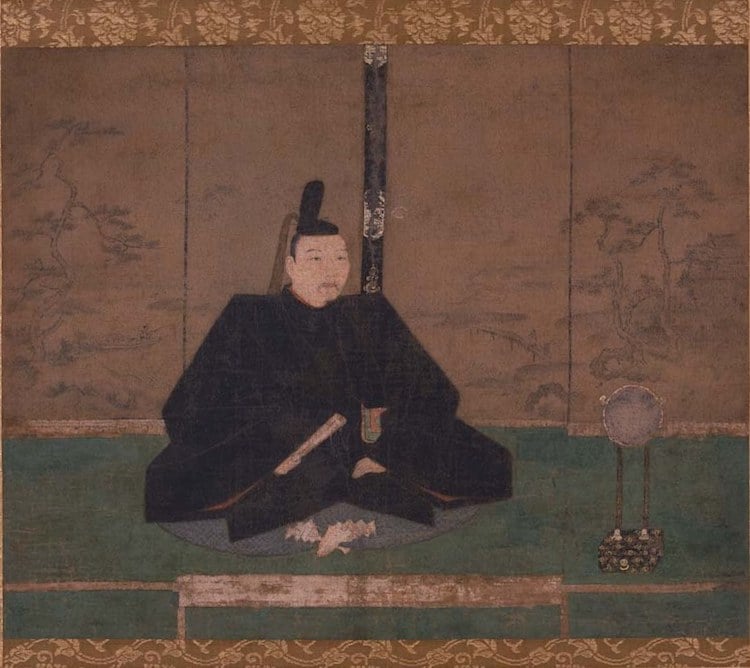
Portrait said to exist of Ashikaga Yoshimasa, 15th century (Photo: Wikimedia Commons, Public domain)
While kintsugi'south origins aren't entirely articulate, historians believe that it dates back to the late 15th century. According to legend, the craft commenced when Japanese shogun Ashikaga Yoshimasa sent a cracked chawan—or tea bowl—back to China to undergo repairs. Upon its return, Yoshimasa was displeased to find that it had been mended with unsightly metal staples. This motivated contemporary craftsmen to detect an alternative, aesthetically pleasing method of repair, and kintsugi was built-in.
By the 17th century, kintsugi has become mutual practise in Nihon. According to Louise Cort (the curator of ceramics at the Freer Gallery of Art and Arthur M. Sackler Gallery), it was during this time that a Japanese warrior infamously purchased, broke, and repaired standard tea bowls in guild to make a profit."That seems to indicate that, by the kickoff of the 17th century, kintsugi was a commonly used technique for repairing—and at the aforementioned fourth dimension, ornamenting—ceramics for tea," Cort explains.
In addition to serving every bit an aesthetic principle, kintsugi has long represented prevalent philosophical ideas. Namely, the practise is related to the Japanese philosophy of wabi-sabi , which calls for seeing beauty in the flawed or imperfect. The repair method was also born from the Japanese feeling of mottainai , which expresses regret when something is wasted, too as mushin , the acceptance of alter.
How to Kintsugi a Broken Bowl
In that location are three predominant styles and methods of kintsugi: crevice, piece method, and joint-call. While, in each instance, gold, silver, or platinum-dusted epoxy is used to set the broken pottery, the techniques and finished results vary.
Crack
Objects mended using the scissure approach are touched upwardly with minimal lacquer. This is the most common kintsugi technique, and it culminates in the shimmering veins that have come up to define the art form.
Slice Method
Works restored with the piece method feature replacement fragments made entirely of epoxy.
Articulation-Call
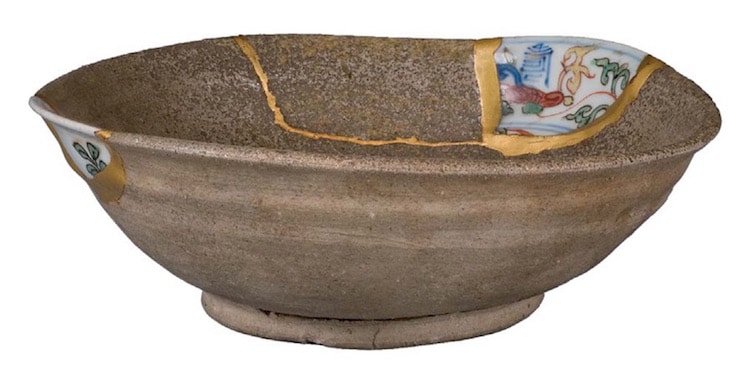
Pieces stock-still using the joint-call technique employ similarly-shaped pieces from other broken wares, combining two aesthetically unlike works into one uniquely unified product.
Kintsugi Today
Many artists and craftspeople today—both in Japan and abroad—continue to keep this ancient tradition alive. Tomomi Kamoshita and Yee Sookyung incorporate the practice into their ceramic art, while Elisa Sheehan, Rachel Sussman, and Tatiane Freitas have put their ain creative twists on the traditional practice past replacing the pottery with anarchistic and unexpected canvases.
Tomomi Kamoshita
Japanese creative person Tomomi Kamoshita breathes new life into plant ceramics. Using the kintsugi technique, she crafts shimmering creations that range from patchwork chopstick rests to mismatched earrings. Much like the kintsugi artists that have come up earlier her, Kamoshita has a philosophical approach to her art. "As every Japanese [person] has realized," she says, "the waves tin can take abroad a great deal from us, simply it is also truthful that we greatly do good from it."
Yee Sookyung
Yee Sookyung uses the kintsugi crevice technique to create surreal sculptures made from multiple wares. Using 24-karat gold, the Korean creative transforms ordinary pottery into Translated Vases that double equally extraordinary allegories. "This work can be a metaphor of a struggle in life that makes people become more mature and cute as they overcome suffering," she reveals.
Elisa Sheehan
Kintsugi Eggshells, an ongoing collection of exquisite installations by New Yorker Elisa Sheehan, sees ephemeral, organic objects transformed into eye-communicable works of fine art. Described as "a visual representation of imperfection equally a true value and where flaws are celebrated and viewed equally beautiful," this series features shells coated in delicate washes of paint, abstract ink forms, and gold leaf accents.
Rachel Sussman
Brooklyn-based artist Rachel Sussman has taken kintsugi to the streets. Using a method inspired past the age-old do, she mends the many cracks that naturally occur in urban environments. Called Sidewalk Kintsukuroi, this longterm project is intended to invite us to "encounter what's around usa with fresh eyes and to gloat perseverance."
Tatiane Freitas
Brazilian artist Tatiane Freitas blurs the line between classic and contemporary design with her mod spin on mending. Using acrylic resin, Freitas "fixes" broken wooden furniture. Though the resin is clear, the repairs are non intended to be camouflaged; instead, the alterations boldly stand out from the wood, culminating in former-meets-new statement pieces.
Bouke de Vries
Dutch artist Brooke de Vries creates remarkable sculptures from fragmented pieces of ceramic. He transforms shattered ceramics into deconstructed sculptures. De Vries' work takes on various forms, but many of them are mended together using the kintsugi technique. His aim is to emphasize the beauty that lies in imperfection, which aligns very well with the philosophy of kintsugi.
If you're interested in channeling your inner creative person and exploring the craft yourself, Humade and Mejiro Japan sell kintsugi repair kits, and A Cozy Kitchen also offers a DIY tutorial for those who have the supplies on-manus. These do-it-yourself projects permit you to experience the fine art of repairing pottery in the Japanese tradition while simultaneously transforming your broken ware into a slice of fine art.
This article has been edited and updated.
Related Articles:
Creative person Uses Japanese Fine art of Kintsugi to Fill in Basketball Courtroom's Cracks With Golden
Craftsman Voluntarily Repairs Whatsoever Family unit Heirloom Ceramics Damaged By Earthquakes in Japan
Broken Vases Are Restored by Sewing Them Back Together with Gold Thread
Origami: How the Ancient Art of Paper Folding Evolved Over Time and Continues to Inspire
Source: https://mymodernmet.com/kintsugi-kintsukuroi/
0 Response to "Japanese Art Where You Put Two Things Together to Create Something Bigger"
Post a Comment