Books Time and Time Again Time Travel
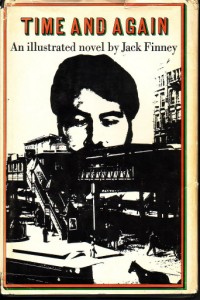 First edition cover | |
| Author | Jack Finney |
|---|---|
| Country | United States |
| Language | English |
| Genre | Scientific discipline fiction |
| Publisher | Simon & Schuster |
| Publication date | 1970 |
| Media type | Impress (Hardcover, Paperback) |
| Pages | 304 |
| ISBN | 0-671-24295-4 (first edition, hardcover) |
| OCLC | 84586 |
Time and Again is a 1970 illustrated novel past American writer Jack Finney. The many illustrations in the volume are real, though, equally explained in an endnote, not all are from 1882, the year in which the main activity of the volume takes place.
A sequel, From Fourth dimension to Fourth dimension (1995), was published during the final twelvemonth of the writer'south life. The book left room for a third novel, manifestly never written.
In the afterword of xi/22/63, Stephen Male monarch states that Time and Again is "in this writer's apprehensive opinion, the great time-travel story." He had originally intended to dedicate his volume to Jack Finney.
Plot [edit]
In Nov 1970, Simon Morley, an ad sketch artist, is approached by U.S. Army Major Ruben Prien to participate in a secret government project. He is taken to a huge warehouse on the West Side of Manhattan, where he views what seem to be movie sets, with people acting on them. It seems this is a projection to learn whether information technology is viable to transport people back into the past by what amounts to self-hypnosis—whether, by convincing oneself that one is in the past, non the present, one can go far and then.
As information technology turns out, Simon (usually called Si) has a good reason to desire to become back to the by—his girlfriend, Kate, has a mystery linked to New York Metropolis in 1882. She has a letter dated from that year, mailed to an Andrew Carmody (a fictional minor effigy who was associated with Grover Cleveland). The letter seems innocuous enough—a request for a meeting to talk over marble—but there is a annotation which, though half burned, seems to say that the sending of the letter led to "the devastation by burn down of the entire World", followed by a missing discussion. Carmody, the writer of the notation, mentioned his blame for that incident. He and so killed himself.
Si agrees to participate in the project, and requests permission to become back to New York City in 1882 in order to lookout man the alphabetic character being mailed (the postmark makes clear when it was mailed). The elderly Dr. Due east.East. Danziger, head of the project, agrees, and expresses his regret that he can't become with Si, because he would love to see his parents' first coming together, which also occurred in New York City in 1882. The projection rents an flat at the famous Dakota apartment building, which did not actually exist in 1882. (It was completed two years later, merely Finney explains that he took a few liberties with the timeline due to his fascination with the building.) Si uses the apartment as both a staging area and a means to help him with cocky-hypnosis, since the building'southward style is so much of the period in which it was built and faces a section of Central Park which, when viewed from the flat'southward window, is unchanged from 1882.

The Dakota in winter. This epitome appears in Affiliate 17 of the novel.
Si is successful in going dorsum to 1882, at commencement very briefly, and then a second fourth dimension he is able to accept Kate with him. They travel past horse-drawn jitney down to the quondam post office, and watch the letter being mailed by a homo. They follow him, and learn that he lives at 19 Gramercy Park. Then they return to their base at the Dakota apartments and return to the present.
Si is debriefed and advisedly examined after each trip to the past, and as far as the project organizers can tell, his activities in the by are making no difference to the present. He is encouraged to get back once more. He presents himself at 19 Gramercy Park as a potential boarder. He is accepted, begins living at that place and learns that the human being who mailed the letter is named Jake Pickering. He explores the Manhattan of the past for several days, sketching all the while—he is an illustrator, and Finney inserts illustrations from the menses into the book as Si's own. He goes on to acquire that Pickering is blackmailing Carmody. Si finds himself falling for the landlady's niece, Julia Charbonneau. Only he has a rival—Pickering. Eventually, Pickering makes a scene, having tattooed the proper name "JULIA" on himself, and Si presently leaves, to return to the present.
Things aren't going as well in the nowadays. One of the other participants in the project, having gone back to Denver some seventy years in the past, has made some unknown change in the past (or then it seems to be assumed by the project leaders as there is no reason why the change couldn't have been made by Si—in fact, more than likely and so as Si had been much more than active in the by than the Denver operative—or another time traveler) and thus a friend, whom he remembers, was never built-in. Danziger insists that the projection be stopped. When he is overruled, he resigns. After Prien talks to him, Si sees no alternative other than to return to the past again, though he is troubled by Danziger'due south resignation.
He is accepted back at Gramercy Park cheerfully, with even the dour Pickering happy. It seems Pickering and Julia are now engaged. Si (casting himself as a private detective) tells Julia that Pickering is a blackmailer. They go to Pickering's office and conceal themselves to watch the blackmail money being turned over by Carmody. Carmody brings merely $10,000, rather than the demanded one thousand thousand dollars for the incriminating files. Afterward knocking him out, Carmody ties up Pickering and sets out to look for the papers. He realizes they are concealed amid many other files. He patiently thumbs through the files, while Si and Julia agonize equally the hours laissez passer. Finally, Carmody decides on a scheme—fire the files. He does so. Pickering tries to save the files, but burns himself badly in the process. To the pair's astonishment, Si and Julia flare-up along, urging them to flee, and flee themselves.
It is a huge burn down, and Si and Julia find themselves trapped. They barely escape. Si learns that the building used to house the newspaper the New York World and one piece of the puzzle fits in—the missing word in Carmody's note was "Building". After watching the efforts to fight the fire, in which many die, the shaken couple returns to Gramercy Park. There is no sign of Pickering. [The burning of the New York World edifice is a factual historical consequence].
Two days later, the two are picked upwardly past Police Inspector Thomas Byrnes, and and so taken to Carmody'south house. Terribly burned and bandaged, Carmody accuses them of murdering Pickering and starting the fire. Subsequently they leave, Byrnes expresses indecision and lets them walk away—only to yell "The prisoners are escaping" to the sergeant who accompanies him. It is a set-upwardly, the two are to show their guilt by "attempting to escape". Every bit it turns out, police all over the island accept already been provided with their description and photographs. They are able to flee, but have no money and nowhere to get. They shelter in the as-yet-unassembled Statue of Liberty's arm, then standing in Madison Square. (Once more, the arm continuing in Madison Square Park prior to the statue equally a whole being erected is a factual consequence). Si tells Julia the whole story, only she takes it as entertaining fantasy. She is shortly convinced otherwise, as Si brings them both into the present, and she observes the dawn from high within the long-assembled statue, seeing a totally strange New York.
They spend a day in the nowadays, with a shocked Julia observing the things that have changed in ninety years, from wearable to goggle box. At final, they settle into Si'southward apartment. He is ashamed to tell her the history of what has happened in the past ninety years, the horrible wars and the fact that there are areas of the city where no law-abiding citizen tin safely go. Julia must render abode. The 2 realize that the human whom they met at Carmody's house was in fact Pickering, who they could not identify considering of the burns and bandages—Carmody had actually died in the fire. Armed with this knowledge, Julia tin can go on Pickering from having her arrested, lest he be exposed. As 1882 is far more real to her than 1970, she returns to the by without needing any assist from Si.
Si goes to report in, and tells most of the story, concealing Julia's visit to 1970. They so give him an assignment—to intentionally alter the past. Enquiry has confirmed that Carmody (really Pickering) was an acquaintance of Grover Cleveland's--and talked Cleveland out of buying Cuba from Spain. The military men at present in effective command of the projection conclude that if Pickering is exposed, he might never have influence with Cleveland, and the U.South. might never take to worry nearly Fidel Castro. Just subsequently talking with Danziger, Si worries well-nigh the other effects the change might take, and Danziger makes him promise not to bear out the scheme. Si returns to 1882. Having learned from Danziger how his parents met past chance, Si interjects himself and prevents their meeting. Considering the parents never run into, Danziger will never be built-in, and the project will never happen. Si walks abroad towards Gramercy Park and Julia, and away from 1970.
Reception [edit]
After criticizing unrealistic scientific discipline fiction, Carl Sagan in 1978 listed Time and Once again as among stories "that are so tautly constructed, and so rich in the accommodating details of an unfamiliar society that they sweep me along before I have even a run a risk to be critical".[1]
[edit]
It had long been rumored that Robert Redford would adapt the book into a movie.[ commendation needed ] The project has never come up to fruition. Though a film of this novel has never been made, a 1980 picture, Somewhere in Time features a similar time travel technique. Information technology is based on the 1975 Richard Matheson novel Bid Time Return. The flick concerns a fellow, Richard Collier, unhappy with his life as a playwright who takes a short road trip to the Grand Hotel on Mackinac Isle for a intermission, to assist relieve the frustration of his author'south block. Killing time before dinner in the Hall of History museum there, he becomes fascinated with an quondam photographic portrait of a stage actress from 1912. He becomes besotted with her image. In researching her life and visiting her home, he discovers she was interested in time travel and owned a book on fourth dimension travel written past his sometime college professor, Dr. Finney. He intercepts the professor in between lectures, to ask him for clarification if time travel is possible? Finney'southward time travel theory mimics Jack Finney's idea of cocky-hypnosis, to remove all items from the present and convince your mind that you are in the verbal environment of the desired destination time. The professor says that he achieved this one time, had travelled back in time in Venice, merely it was only for an instant, a fraction of a second. Collier, enthused, then seeks to replicate the experiment for himself.
In July 2012, information technology was announced that Lionsgate studios optioned the film rights to the novel, with Doug Liman gear up to direct and produce.
References [edit]
- ^ Sagan, Carl (1978-05-28). "Growing upwardly with Science Fiction". The New York Times. p. SM7. ISSN 0362-4331. Archived from the original on 2018-12-11. Retrieved 2018-12-12 .
Source: https://en.wikipedia.org/wiki/Time_and_Again_(Finney_novel)
0 Response to "Books Time and Time Again Time Travel"
Post a Comment